
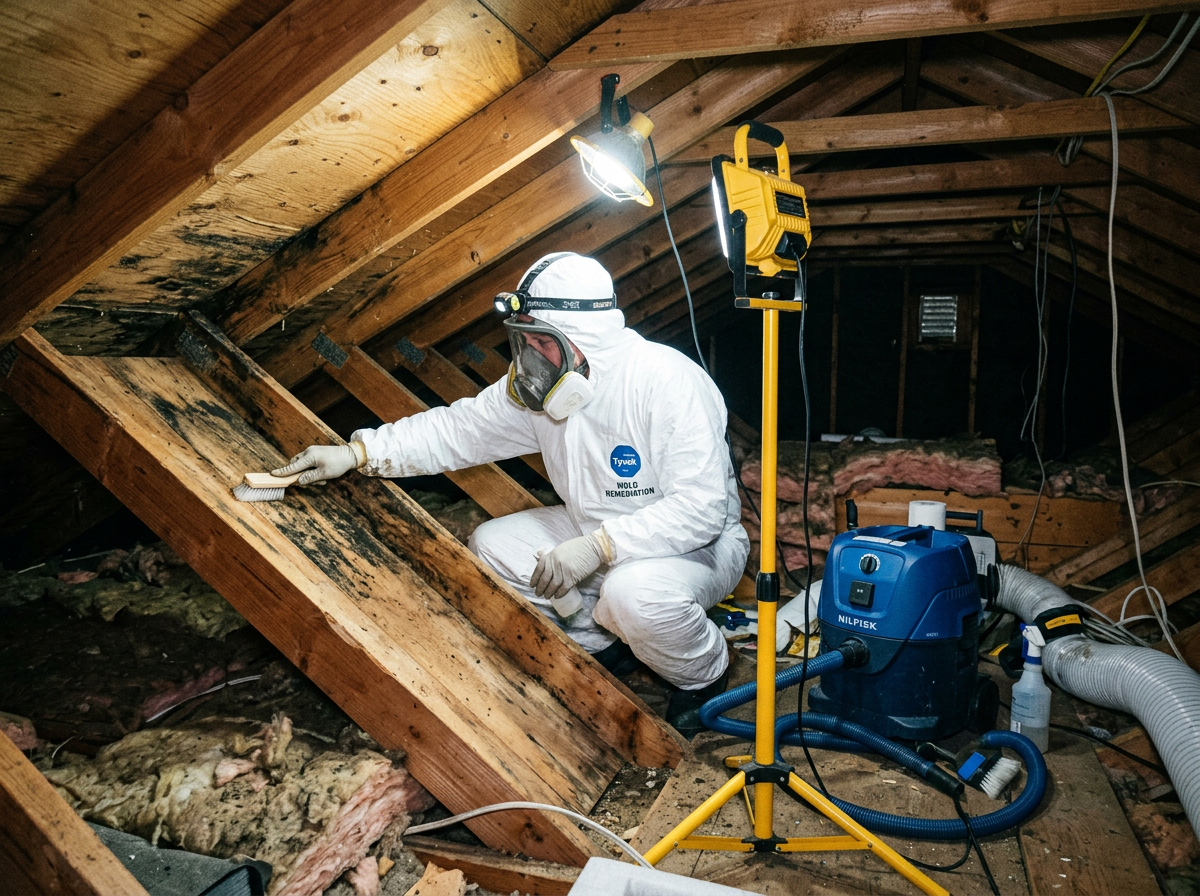
Attic mold in Washington almost always traces back to ventilation failures rather than roof leaks. Bath fans and dryer exhausts terminate inside the attic, soffit vents get blocked by insulation, and eaves are stuffed so air cannot flow up to the ridge. The north-facing slope of the roof sheathing stays coldest and shows black staining first because maritime air west of the Cascades keeps wood damp for nine months of the year. Materials never dry out fully, so growth returns unless the airflow path is restored.
Cleaning begins with containment and negative air to keep spores out of living spaces. Technicians remove loose insulation, then scrub or media-blast the sheathing to remove surface growth. When the plywood or OSB has lost structural integrity or the mold has penetrated the back side, sections must be cut out and replaced. Simply spraying an encapsulant over active growth without fixing fan terminations and clearing soffits only hides the problem; the next heating season pushes more moisture upward and the staining reappears.
Attic Mold Removal Near You — Choose Your City
Every city below has its own local Attic Mold Removal page with coverage details.
Snohomish County
Spokane County
Skagit County
Spokane
King County
Whatcom County
Snohomish
Wahkiakum County
Pierce County
Whatcom
Franklin
Benton
King
Franklin County
Skagit
Benton County
Pierce
Eastern Washington jobs differ sharply because the Columbia Basin stays arid. Mold there usually starts from plumbing leaks or whole-house humidifiers rather than roof ventilation. The same cleaning steps apply, but the diagnosis focuses on finding the single water source instead of reworking the entire attic airflow system.
Stack effect from bare-soil crawl spaces can push additional moisture into the attic through floor penetrations, so any attic project includes a quick check of the crawl space vapor barrier and floor penetrations before final clearance.
Technician insight
In Lynnwood, the thing that catches most people out with Attic Mold Removal is how 1970s and 1980s split-levels have insulation blown over the eaves on the north side, completely stopping any airflow even when the ridge vent looks open. Homeowners fix the obvious fan and still see the stain return the next winter because the cold sheathing never dries.
Lynnwood Split-Level Attic
Bath and dryer fans terminated inside the attic with insulation covering the north eaves. Black staining covered the north slope sheathing while the south slope stayed clean. Fans were re-terminated through the roof, soffits were cleared and baffled, stained sheathing was media-blasted, and new insulation was installed after clearance testing.
Attic Mold Removal Services We Offer
✓Sheathing Cleaning and Treatment
Media blast or hand scrubbing of stained roof sheathing followed by application of an antimicrobial coating once moisture sources are corrected.
✓Bath and Dryer Fan Re-Termination
Rerouting existing bath and dryer ducts through the roof or gable so moist air exits the attic instead of discharging into it.
✓Soffit and Baffle Clearing
Removal of insulation blocking eaves and installation of proper baffles to restore continuous airflow from soffit to ridge.
✓Insulation Removal and Replacement
Extraction of contaminated insulation, disposal, and installation of new material after ventilation and sheathing work are complete.
✓Post-Remediation Verification
Moisture meter readings and visual inspection of all treated surfaces to confirm the attic meets clearance standards before insulation is replaced.
How it works
- 1
Source Diagnosis
Technicians inspect fan terminations, soffit clearance, insulation placement at the eaves, and any crawl space contribution to attic moisture.
- 2
Containment and Removal
Negative air is established, affected insulation is removed, and stained sheathing is cleaned or replaced as needed.
- 3
Ventilation Correction
Bath and dryer fans are re-terminated, soffits are cleared, and baffles are installed to restore proper airflow.
- 4
Clearance and Restoration
Moisture levels are verified, new insulation is installed, and the attic is returned to service.
Pricing
Scope depends on how many fans need re-termination, the amount of sheathing that must be replaced, and whether the crawl space is contributing moisture; call for an inspection-based quote.