
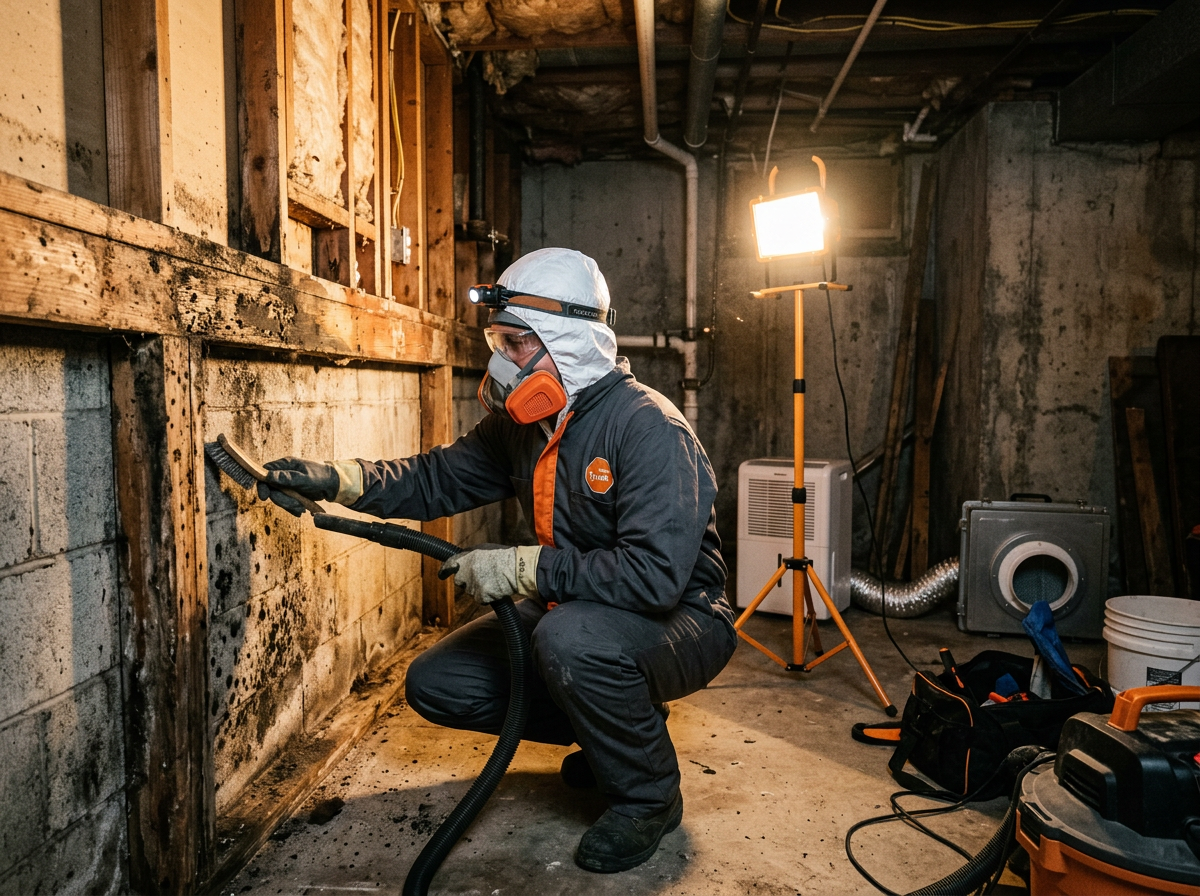
In Lynnwood basements, mold typically appears first along the north and west foundation walls where exterior grade sits highest and rain soaks the soil against the concrete. Bare soil crawl spaces beneath the house allow constant moisture migration upward through the floor joists by stack effect, especially once winter temperatures drop and the house pulls air from below. When insulation is present on basement walls it often traps the damp against the concrete, turning a small leak into widespread growth behind the material.
Remediation starts with locating every water entry point, including hairline cracks in the slab, failed window wells, and missing or clogged perimeter drains common in homes built before 1990. Containment is set up to keep spores from moving into living areas, then affected materials are removed or cleaned depending on porosity. Simply spraying the walls without correcting the water source guarantees recurrence within one or two wet seasons.
Basement Mold Removal Near You — Choose Your City
Every city below has its own local Basement Mold Removal page with coverage details.
Snohomish County
Spokane County
Skagit County
Spokane
King County
Whatcom County
Snohomish
Wahkiakum County
Pierce County
Whatcom
Franklin
Benton
King
Franklin County
Skagit
Benton County
Pierce
After removal the space must be dried to below 50 percent relative humidity using dehumidification sized for the actual cubic footage and airflow patterns of the basement. In many Lynnwood properties this also means installing or repairing a vapor barrier in the crawl space above to break the stack-effect loop. Final verification includes moisture meter readings on all previously affected surfaces rather than visual inspection alone.
Common Moisture Sources in Western Washington Basements
Homeowners often overlook how gutter overflow and negative grading around the foundation keep soil saturated against the walls for months at a time, feeding mold long after any visible leak stops.
Technician insight
In Lynnwood the thing that catches most people out with Basement Mold Removal is the stack effect from 1950s-1970s crawl spaces that have no vapor barrier at all. Once we dry the basement walls the moisture just keeps rising from the dirt floor above unless that barrier goes in the same week.
North Lynnwood Split-Level Basement
Water had been entering along the west foundation wall for years, soaking the insulation behind drywall. We found the crawl space soil completely exposed and the perimeter drain clogged with roots. After removing wet insulation, cleaning the concrete, and installing a sealed vapor barrier overhead, the basement stayed below 45 percent humidity through the next winter.
Basement Mold Removal Services We Offer
✓Foundation Wall Treatment
Cleaning and antimicrobial treatment of concrete and block walls after water intrusion, followed by drying to prevent re-growth behind finished surfaces.
✓Crawl Space Vapour Barrier Installation
Sealing bare soil in the crawl space directly above the basement to stop stack-effect moisture from rising into the living area.
✓Sump Pump and Drainage Assessment
Inspection and repair of existing sump systems plus recommendations for French drain tie-ins when perimeter water is entering the basement slab.
✓Basement Insulation Removal and Replacement
Safe removal of wet fiberglass or foam board, wall drying, and installation of new insulation only after the moisture source is corrected.
✓Dehumidification System Setup
Sizing and placement of whole-basement dehumidifiers with proper condensate drainage to maintain humidity below 50 percent year-round.
✓Post-Remediation Verification
Moisture meter and visual inspection of all treated surfaces to confirm the space has returned to dry, stable conditions before any finishing work.
How it works
- 1
Source Identification
We map every water entry point using moisture meters and visual inspection of grading, gutters, and the crawl space above.
- 2
Containment and Removal
Plastic barriers isolate the work area while porous materials are removed and non-porous surfaces are cleaned.
- 3
Drying and Moisture Control
Industrial dehumidifiers and air movers bring the space to target humidity levels; vapor barriers are installed where needed.
- 4
Verification
Final moisture readings and visual checks confirm the basement is dry before any reconstruction begins.
Pricing
Scope depends on square footage, depth of moisture in walls and slab, and whether crawl-space vapor barrier work is required; call for an on-site inspection and written quote.