
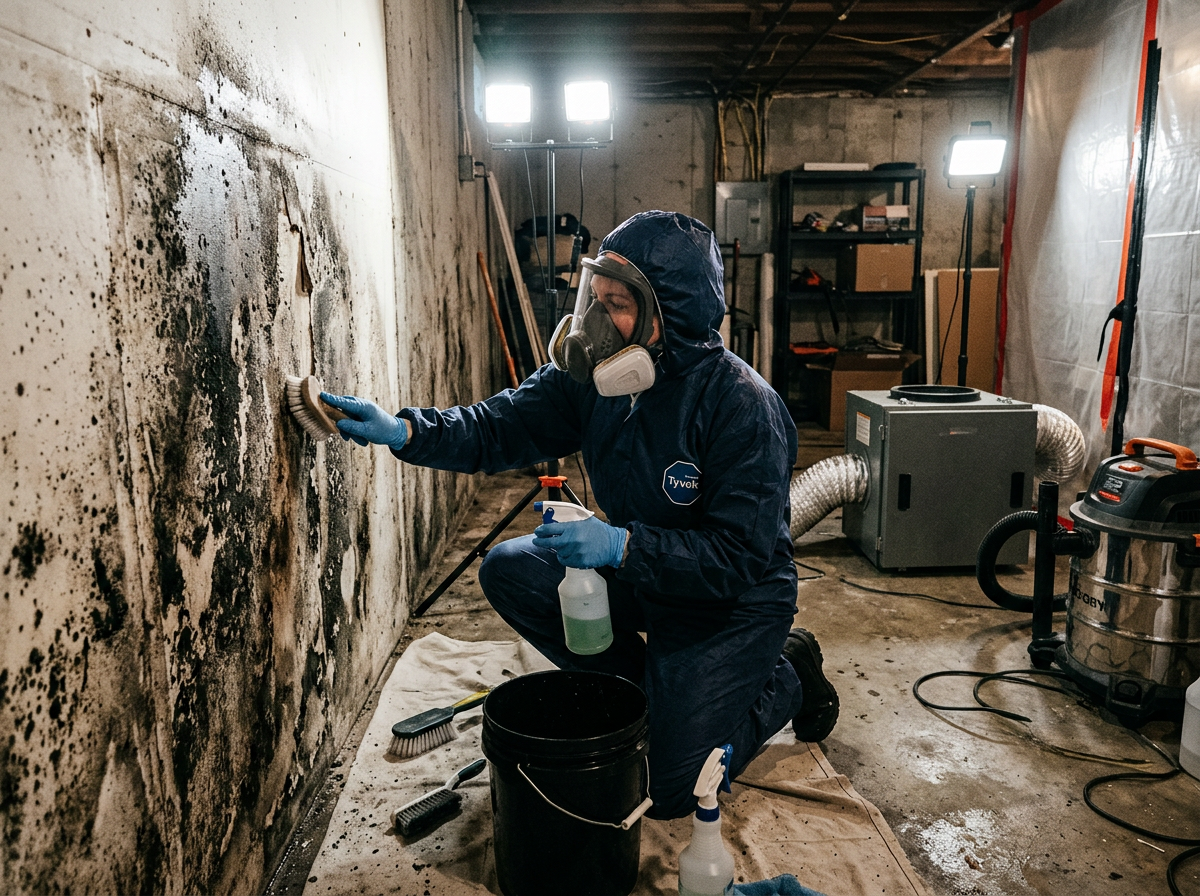
In western Washington attics black mold typically appears first on the north slope of the roof sheathing where cold surfaces meet persistent maritime moisture. The root cause is almost always ventilation failure: bath and dryer exhausts terminating inside the attic, insulation packed over the eaves, or soffit vents blocked by debris and paint. Without correcting airflow the sheathing stays damp nine months of the year and any surface treatment fails within a season. Eastern Washington jobs more often trace to plumbing leaks or excessive indoor humidity rather than climate-driven condensation.
Remediation starts with isolating the attic, removing contaminated insulation, and cleaning sheathing with HEPA vacuuming followed by appropriate antimicrobial application only after the surface is dry. When mold has penetrated the wood grain or the OSB has delaminated, sections of sheathing must be cut out and replaced rather than cleaned. Encapsulation coatings applied before airflow is restored simply trap moisture behind a film and guarantee recurrence. Post-cleaning verification includes moisture readings below 12 percent and visual confirmation that all visible growth is gone.
Black Mold Removal Near You — Choose Your City
Every city below has its own local Black Mold Removal page with coverage details.
Snohomish County
Spokane County
Skagit County
Spokane
King County
Whatcom County
Snohomish
Wahkiakum County
Pierce County
Whatcom
Franklin
Benton
King
Franklin County
Skagit
Benton County
Pierce
Homeowners often attempt DIY sprays or foggers that mask odor without addressing the moisture source. In Lynnwood homes built before 1990 the combination of older roof decks and upgraded insulation frequently creates hidden pockets along the eaves that only become visible once insulation is pulled. Full correction requires re-terminating exhaust fans through the roof, clearing soffits, and ensuring baffles maintain an open air channel. Without these steps any removal work is temporary at best.
Technician insight
In Lynnwood the thing that catches most people out with Black Mold Removal is insulation stuffed tight against the eaves on 1970s-1980s split-levels. Once you pull that batt back you find the soffit completely blocked and the north sheathing already stained black, even though the rest of the attic looks fine from the hatch.
Lynnwood Split-Level Attic
Bath fan vented into the attic and insulation covering the eaves had kept the north sheathing damp for years. We removed the wet insulation, cleaned the sheathing where growth was surface-level, rerouted the fan through the roof, and cleared the soffits. New insulation was installed only after moisture readings stayed under 12 percent.
Black Mold Removal Services We Offer
✓Sheathing Cleaning and Treatment
HEPA vacuuming and surface treatment of roof sheathing after insulation removal, performed only after ventilation issues are identified.
✓Bath and Dryer Fan Re-Termination
Rerouting interior-vented exhaust fans through the roof or gable to stop direct moisture introduction into the attic space.
✓Soffit and Baffle Clearing
Removing insulation, debris, and paint from soffit vents and installing or repairing baffles to restore proper airflow along the roof deck.
✓Insulation Removal and Replacement
Extraction of contaminated insulation followed by installation of new material once the attic is dry and ventilation is corrected.
✓Post-Remediation Verification
Moisture meter readings and visual inspection confirming the attic meets dry standards before any new insulation or coatings are applied.
How it works
- 1
Source Diagnosis
Inspect fan terminations, soffit clearance, and insulation placement to identify why moisture persists in the attic.
- 2
Containment and Removal
Isolate the work area, remove affected insulation, and clean or replace contaminated sheathing as needed.
- 3
Ventilation Correction
Re-terminate exhausts, clear soffits, and restore airflow paths so materials can dry between seasons.
- 4
Verification and Restoration
Confirm dryness with meters, document conditions, and prepare the space for new insulation installation.
Pricing
Scope depends on attic size, extent of sheathing involvement, and number of ventilation corrections required. Call for an inspection and written scope.