
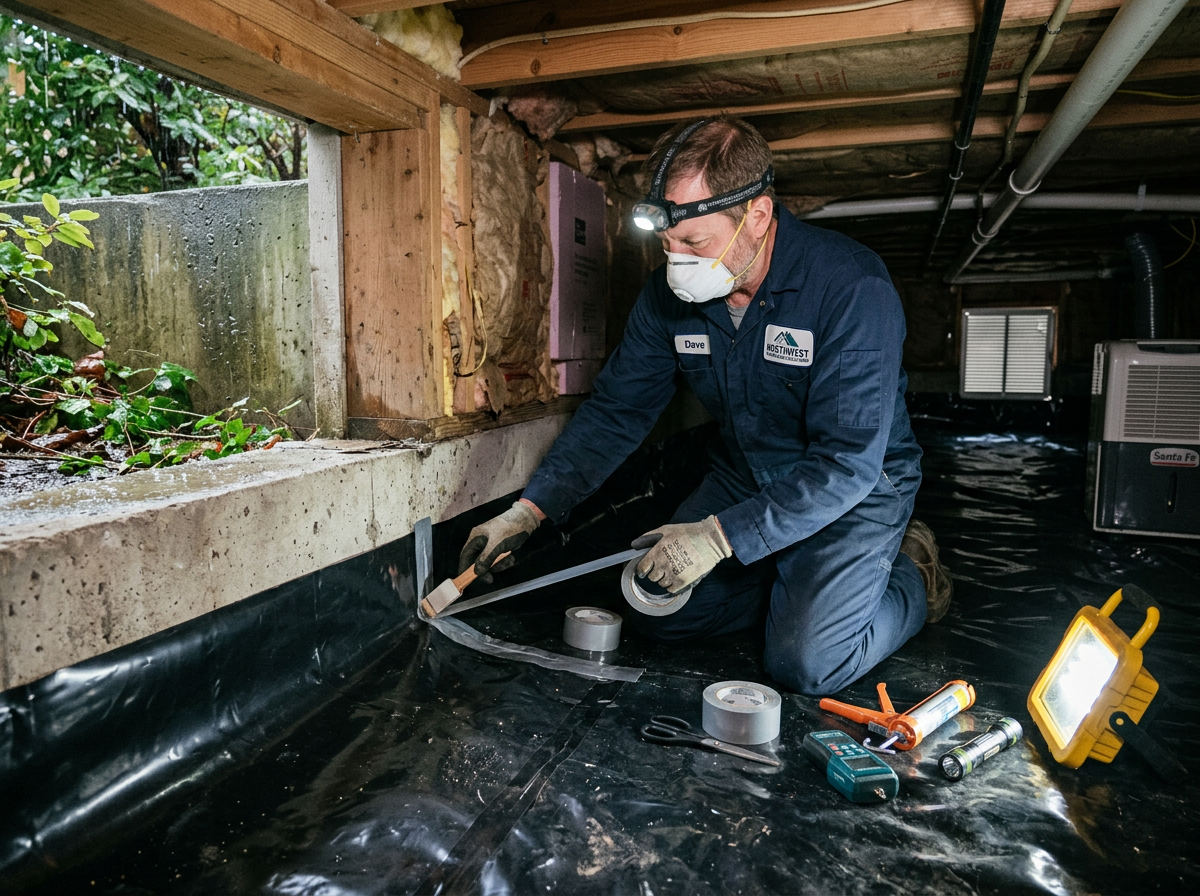
West of the Cascades, nine months of maritime damp keeps attics and crawl spaces from drying out once moisture enters. The most common entry points are bath and dryer fans venting into the attic instead of outside, soffit vents blocked by insulation, and bare soil crawl spaces that send humidity upward through stack effect. These conditions stain the north slope of roof sheathing first because it stays coldest. Without fixing the airflow paths and ground moisture, any surface cleaning fails within a season.
Effective work starts with tracing every exhaust duct to its actual termination and clearing insulation that has been stuffed over the eaves. In older Lynnwood neighborhoods, many homes from the 1970s and 1980s still have dryer ducts ending inside the attic or crawl space. Adding a vapour barrier over bare soil and restoring soffit baffles lets air move again. Dehumidification is added only after the ventilation paths are open; otherwise the unit simply runs constantly without solving the source.
Moisture Control and Prevention Near You — Choose Your City
Every city below has its own local Moisture Control and Prevention page with coverage details.
Snohomish County
Spokane County
Skagit County
Spokane
King County
Whatcom County
Snohomish
Wahkiakum County
Pierce County
Whatcom
Franklin
Benton
King
Franklin County
Skagit
Benton County
Pierce
Jobs fail when crews clean visible growth but leave the fans or blocked eaves untouched. Sheathing can usually be cleaned and treated unless delamination has occurred; replacement is required only when the wood is soft or the fasteners no longer hold. Eastern Washington jobs differ because the dry climate means most moisture comes from plumbing leaks rather than weather, so diagnosis focuses on those point sources instead of broad ventilation fixes.
Technician insight
In Lynnwood, the thing that catches most people out with Moisture Control and Prevention is how many 1970s-1980s split-levels still have the dryer venting straight into the attic and insulation piled over the eaves; the constant maritime damp means those two details alone keep sheathing wet all winter.
Lynnwood Split-Level Attic Moisture
Bath and dryer fans terminated inside the attic with insulation blocking the soffits. We rerouted both ducts through the roof, cleared the eaves, and added a vapour barrier in the crawl space. Air now moves from intake to ridge and moisture readings dropped below 12 percent on the north sheathing.
Moisture Control and Prevention Services We Offer
✓Ventilation Assessment
Full inspection of every exhaust fan termination, soffit opening, and ridge vent to locate where moist air is trapped inside the structure.
✓Bath and Dryer Fan Re-Termination
Rerouting existing ducts so they exit through the roof or exterior wall instead of discharging into the attic or crawl space.
✓Soffit and Baffle Clearing
Removing insulation that blocks eave vents and installing proper baffles so outside air can reach the ridge without obstruction.
✓Vapour Barrier Installation
Sealing bare soil in crawl spaces with heavy-duty liner and taping seams to cut off the upward moisture flow that feeds upper levels.
✓Dehumidification Setup
Placing and calibrating a whole-house or crawl-space unit after ventilation paths are corrected so humidity stays below mold-growth thresholds.
✓Gutter and Drainage Correction
Adjusting downspouts, extending leaders, and improving grading around the foundation to keep rainwater from entering crawl spaces and basements.
How it works
- 1
Site Inspection
Map every fan duct, check soffit clearance, and measure moisture levels in sheathing and subfloor.
- 2
Source Correction
Re-terminate fans, clear blocked eaves, and install vapour barrier where bare soil is present.
- 3
Airflow Restoration
Verify soffit and ridge vents are open and test that air moves from intake to exhaust.
- 4
Verification
Re-check moisture readings and confirm no new condensation forms on the north slope or subfloor.
Pricing
Scope depends on how many fans need rerouting, the size of the crawl space, and whether additional dehumidification is required. Call for an inspection and quote.