
2026-09-14 ·
Improving Attic Ventilation To Reduce Mold Risk In Lynnwood
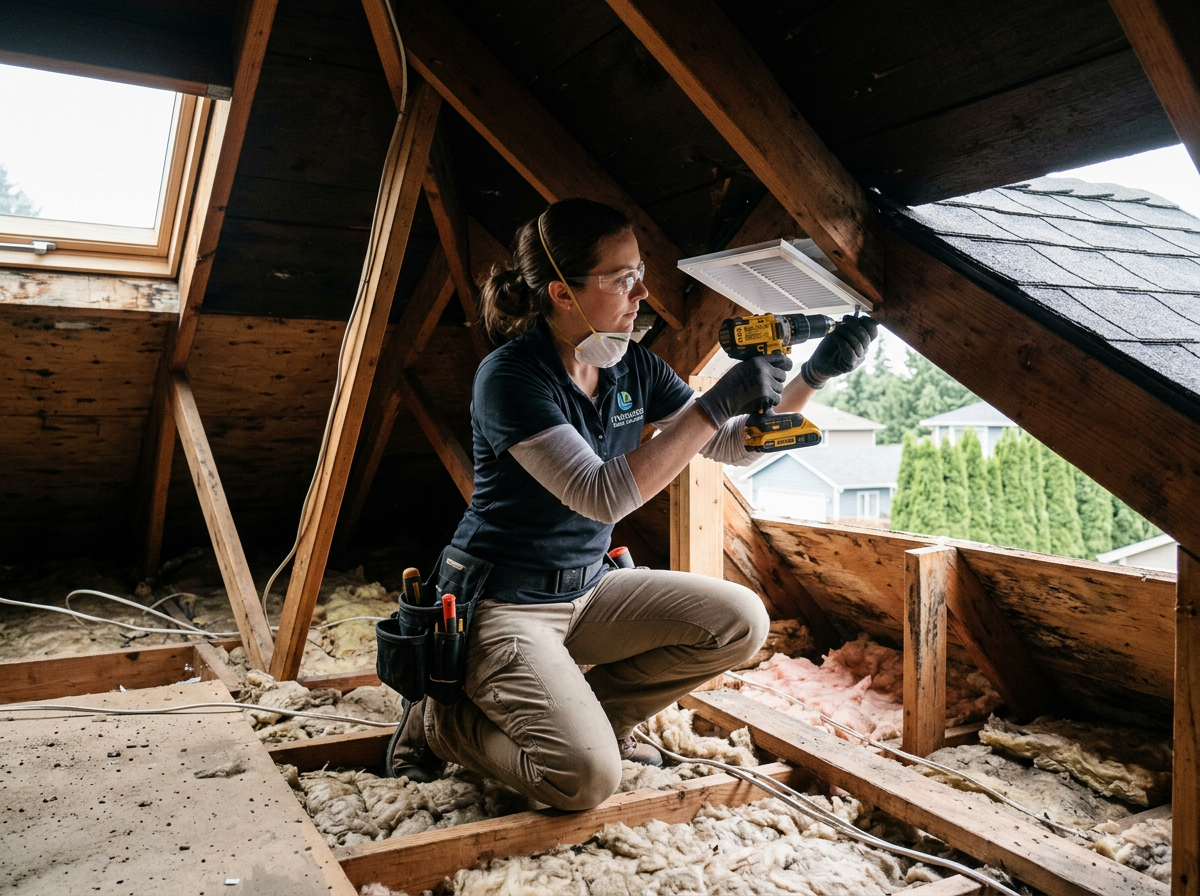
Improving attic ventilation in Lynnwood starts with confirming at least 1 square foot of net free vent area for every 150 square feet of attic floor space while ensuring intake at the eaves and exhaust at the ridge or gable ends remain unobstructed. This balance prevents the stack effect from pulling moist air from bare-soil crawl spaces upward through the living area and into the attic. Many homes west of the Cascades see problems when bathroom or dryer fans exhaust directly into the attic instead of through dedicated ducts to the exterior.
Understanding Ventilation Shortfalls in Lynnwood Attics
Lynnwood attics often develop mold when soffit vents are blocked by insulation or when ridge vents sit above areas with no corresponding intake. North-facing slopes receive less sun and stay cooler, allowing condensation to form on sheathing during the long damp season. The stack effect worsens this by drawing air from lower levels where moisture evaporates from exposed soil. Blocked eaves combined with powered fans venting indoors create pockets of high humidity that never reach the outside. Checking for these patterns requires looking inside the attic during cooler months when temperature differences make airflow visible through insulation movement or staining.
Addressing Intake and Exhaust Paths
Effective fixes begin at the eaves by clearing any insulation that covers soffit vents and installing vent baffles to maintain a clear channel along the roof deck. Ridge or gable vents then provide the upper exit point, but only when intake area matches or exceeds exhaust area. In homes with hip roofs, additional mushroom vents or off-ridge exhaust may be needed to reach the 1-to-150 ratio. Eastern Washington properties face different mechanical issues such as oversized exhaust fans without makeup air, yet the same principle applies: equalize intake and exhaust so air moves continuously. These adjustments reduce the time moist air lingers against wood surfaces.
Connecting Crawl Space Conditions to Attic Airflow
Bare soil in crawl spaces contributes moisture that the stack effect carries upward, especially when attic ventilation cannot remove it fast enough. Sealing the crawl with a 6-mil vapor barrier overlapped at least 12 inches at seams and running up the foundation walls limits the source. Once that source is reduced, attic vents can handle the remaining load without constant saturation. Properties in areas like Mukilteo and Mountlake Terrace share similar crawl-to-attic pathways because of the same maritime climate patterns. Addressing both levels together prevents the cycle from restarting after each rain event.
Monitoring Performance After Changes
After adding or clearing vents, check attic conditions on a cool morning when outdoor temperatures sit near 40 degrees and indoor air is warmer. Look for frost or water droplets on the underside of the roof deck; their absence indicates airflow is now removing moisture. Battery-powered humidity sensors placed in the attic can track readings over several weeks, with the goal of staying below 60 percent relative humidity during the wettest months. Re-inspect insulation for signs of settling or staining near the eaves where new baffles were added. These observations confirm whether the ventilation changes are working under actual Lynnwood conditions.
When Further Steps Become Necessary
If staining persists on north slopes despite clear vents and balanced intake, the next step is a full inspection that includes checking for roof leaks or insulation gaps. Attic mold removal may be required when growth is already established, followed by moisture control and prevention measures to stop recurrence. Readers can also review why Lynnwood attics develop mold during winter and common building materials that trap moisture in Lynnwood attics for additional context on local patterns. Washington Mold Solutions at 19921 68th Ave W Ste 103, Lynnwood, WA 98036 can evaluate specific homes when homeowners want confirmation that ventilation changes have addressed the root sources.